
If you’re a founder, startup, or small business in Australia looking to get your software application off the ground, you may be considering hiring a software company to build your product. What many founders don’t realise is that government programs exist that can help offset some of these costs — the R&D Tax Incentive being one of the most well-known.
It’s important to note here that this article isn’t expert advice. I’m not an accountant or R&D consultant. The goal here is simply to raise awareness of programs you might be eligible for, so you can explore whether they fit your business.
What Is the R&D Tax Incentive?
The Australian Government encourages innovation by providing a tax offset or cash refund for eligible research and development activities.
Key points:
- Businesses under $20M turnover may receive up to 43.5% back on eligible R&D expenditure
- Loss-making startups may receive cash refunds, not just tax deductions
- Software development can qualify when it involves technical uncertainty and experimentation
The program is administered by AusIndustry and the Australian Taxation Office.
Sources:
- https://business.gov.au/grants-and-programs/research-and-development-tax-incentive
- https://www.ato.gov.au/businesses-and-organisations/income-deductions-and-concessions/incentives-and-concessions/research-and-development-tax-incentive
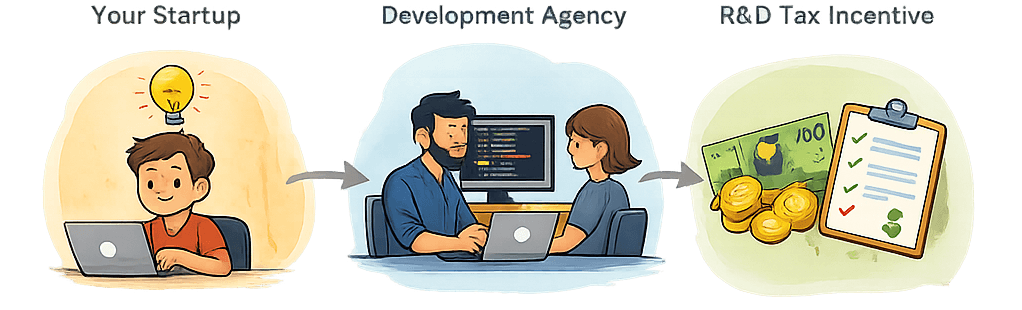
Why It Matters for Businesses Without In-House Development
Many founders assume R&D incentives are only relevant if you have developers on your payroll. But that’s not always the case.
Even if you hire an external software company like MyWebTeam, you may still be eligible to claim some of those development costs, provided that:
- Your business funds the work
- You own the results / IP
- You bear the technical risk
- The project costs justify the R&D requirements, eligibility, and time
In simple terms: if you pay a software partner to solve a technically uncertain problem, you may be able to include those fees in your R&D claim — potentially lowering your net cost.
What Types of Work Might Qualify?
Eligibility revolves around technical uncertainty and systematic experimentation. Here’s a non-technical overview:
| Potentially Eligible | Usually Not Eligible |
|---|---|
| Solving unknown technical problems | Standard feature implementation |
| Experimenting with different technical approaches | Routine software integration |
| Building new algorithms or calculation engines | Basic sorting/filtering |
| Designing novel architecture patterns | Standard create, update and delete (CRUD) based apps |
| Scaling systems beyond known limits | UI/UX improvements |
| Performance or concurrency experimentation | Bug fixes |
| Custom data processing solutions | Routine server upgrades |
Examples business owners might relate to:
- Testing multiple approaches to handle high user load
- Designing a custom recommendation engine
- Developing a unique scheduling or pricing algorithm
- Solving multi-region or concurrency challenges
Non-qualifying work: simple dashboards, basic forms, cosmetic UI changes, or standard API integration.
Pros for Startups and Small Businesses
- Reduces the net cost of hiring a software partner
- Provides cash flow support even before your product generates revenue
- Encourages tackling genuinely innovative technical challenges
- Can make more ambitious projects financially viable
Cons / Things to Keep in Mind
- Documentation is required: you’ll need to show what was uncertain, what experiments were conducted, and what outcomes resulted. This will likely involve more time and work from your development team, increasing the overall development costs.
- You may need to invest a lot of your time to go through the eligibility criteria, paperwork and process to get the funding
- You can engage with R&D consultants who can help you reduce your time and involvement; however, the costs with these consultants will further offset any final financial benefit.
- Eligibility can be grey — not all software development work qualifies
How Startups Can Approach This
- Ask your software partner early whether your project involves technical uncertainty or experimentation — this helps identify eligible work.
- Keep records of project objectives, experimentation, and technical outcomes.
- Talk to your accountant, or engage with an R&D specialist to confirm eligibility and help prepare the claim.
- Remember: even if some work doesn’t qualify, any eligible portion can reduce net costs, which can free up resources for other areas of your business.
Bottom Line
If you’re a startup or small business and are looking to build a SaaS product, and you either have your own in-house software team or partner with external agencies like MyWebTeam, R&D incentives are worth at least exploring. They can offset some of the cost of hiring a software partner or in-house teams, giving you more runway to innovate without giving up equity in external funding.
You should always seek independent guidance to determine eligibility. But being aware of these programs could make your software investment significantly more cost-effective.
Need Enterprise DevOps or Technical Leadership?
For AWS consulting, DevOps, Virtual CTO services, infrastructure architecture, and software delivery consulting, visit our sister company: